Image


Official websites use
.gov
A .gov website belongs to an official government organization in the United States.

Secure
.gov
websites use HTTPS
A
lock
(
)
or
https://
means you’ve safely connected to the
.gov
website. Share sensitive information only on official, secure websites.
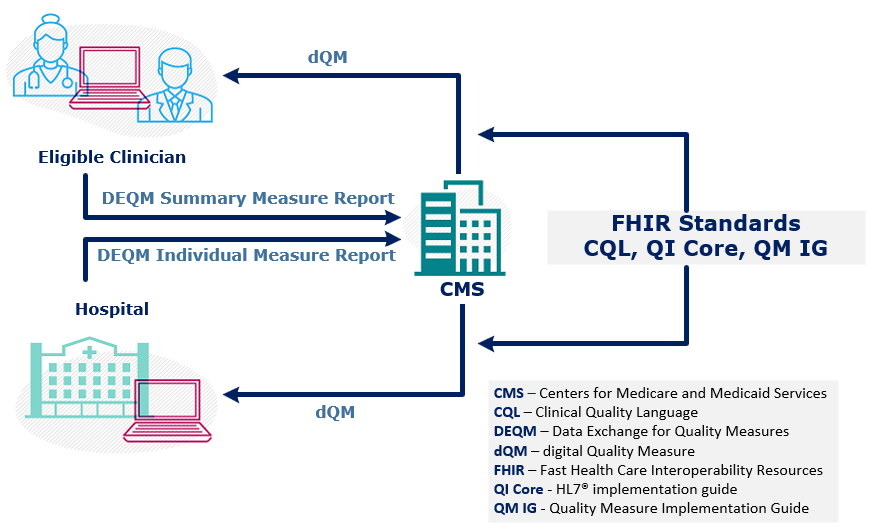
Digital quality measure (dQM) standards are essential for supporting consistent, valid, and interoperable quality measurement. In health information technology, standards establish agreed upon requirements for how health information is represented, structured, exchanged, and interpreted across systems. These standards may address data models and formats, exchange mechanisms, resource structures, terminology, and the meaning of coded clinical concepts. Together, they help ensure that data used for quality measurement can be exchanged and evaluated consistently across different health information systems. For more information about health IT standards and related initiatives, visit the Interoperability Standards Platform. Learn more about CMS’s transition from eCQMs to dQMs for quality reporting programs here.
Clinical Quality Language (CQL) - An HL7 domain-specific language used to express computable clinical logic, including data retrieval criteria, calculations, population logic, and other expressions used in quality measures and clinical decision support. CQL is translated into the Expression Logical Model (ELM), a machine-readable, platform-independent representation of the CQL logic.
Fast Healthcare Interoperability Resources® (FHIR®) - An HL7 standard for representing and exchanging health information electronically. FHIR provides the foundational resources and data exchange framework used by FHIR-based quality measurement.
Data Exchange for Quality Measures (DEQM) Implementation Guide (IG) - Defines FHIR-based interactions, profiles, and guidance for exchanging quality related date and quality measures reports, including individual, subject-list, and summary reporting scenarios.
US Quality Core Implementation Guide (IG) - For CMS-focused dQMs, US Quality Core is the emerging FHIR-based clinical data model used to represent quality-related data requirements. It builds on US Core and is intended to support standardized representation and exchange of data used for digital quality measurement.
Quality Improvement Core Implementation Guide (QI-Core) - Defines a set of FHIR profiles with extensions and bindings to create interoperable, quality-focused applications with and support for quality improvement data within healthcare systems in the US Realm used in the creation of dQMs and clinical decision support (CDS) artifacts.
FHIR Quality Measure Implementation Guide (QM IG) - Defines conformance profiles and guidance for quality measures using the FHIR Measure and Library resources, the FHIR Clinical Reasoning Module and CQL. It standardizes how computable quality measure content is represented and exchanged, rather than defining the clinical data model itself.