Image


Official websites use
.gov
A .gov website belongs to an official government organization in the United States.

Secure
.gov
websites use HTTPS
A
lock
(
)
or
https://
means you’ve safely connected to the
.gov
website. Share sensitive information only on official, secure websites.
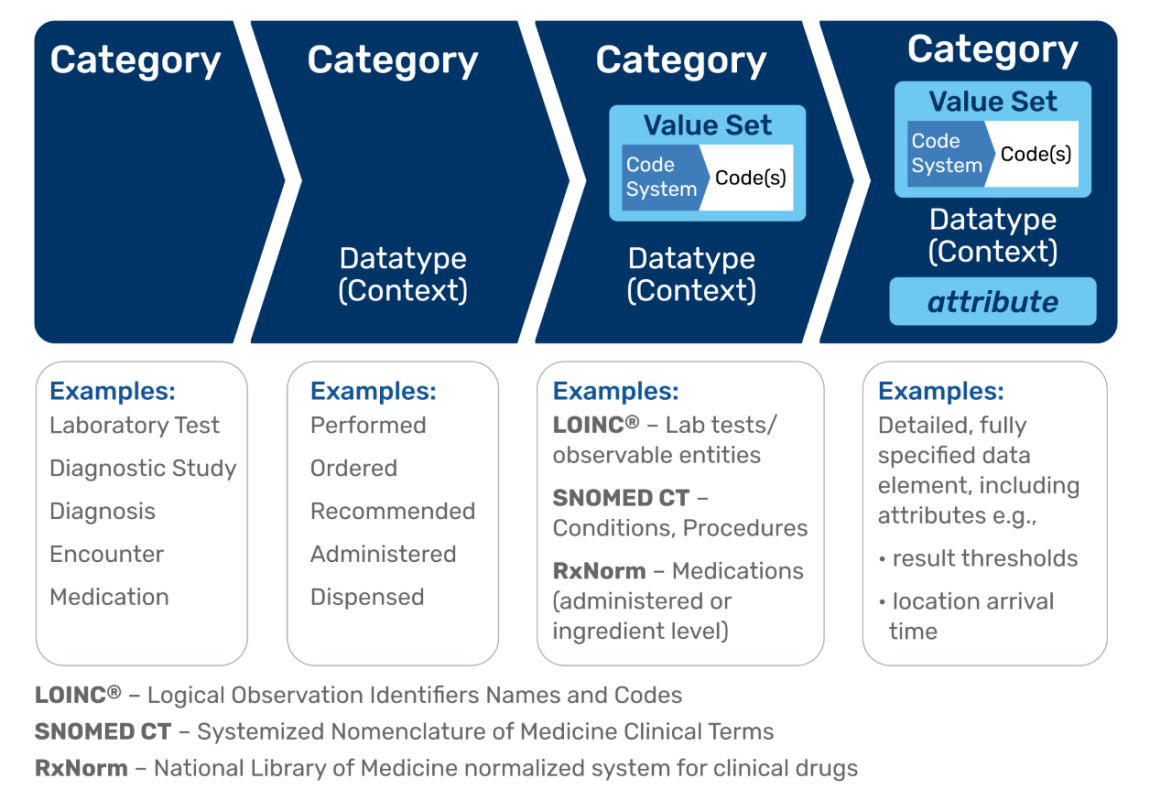
The Quality Data Model (QDM) is a conceptual information model that defines clinical patient data and concepts in a standardized format to enable electronic quality performance measurement. It defines key information concepts (Categories), the context (Datatype) in which the category is used (e.g., performed, ordered), and their details (Attributes) (e.g., relevantPeriod, result). The model is the current structure for electronically representing quality measure concepts for stakeholders involved in electronic quality measure development and reporting. Electronic health record systems can use the QDM to consistently represent and interpret clinical data needed to meet measure criteria.
CMS established the Quality Data Implementation (QDI) User Group to provide a collaborative, multi-stakeholder forum to guide the development, implementation, maintenance, and harmonization of quality data models used in healthcare quality measurement and improvement. Participants of this open stakeholder group use their expertise to provide feedback and influence electronic data modeling based on
The broader focus of this group allows for discussion around emerging quality measurement standards like Fast Healthcare Interoperability Resources® (FHIR®) and Quality Improvement (QI) Core in addition to the QDM data model.
You can review the QDI User Group Charter for more information about the group. To get involved or provide feedback, refer to the Connect tab.
The QDM provides the language that defines the criteria for clinical quality measurement. The graphic below shows how QDM allows for the electronic definition of a clinical concept via its data elements and provides the vocabulary to relate these elements to each other. By relating attributes between data elements and using filtering functions, the QDM provides a method to construct complex clinical representations for eCQMs. The QDM provides the foundation for the conceptualization and specification phases in the eCQM Measure Lifecycle.
Category - A QDM category is a high-level grouping of clinical concepts. Some examples of categories are Medication, Procedure, Condition/Diagnosis/Problem, Communication, and Encounter.
Datatype - The context in which each category describes a part of the clinical care process. Examples of QDM datatypes include “Medication, Active” and “Medication, Administered” as applied to the QDM Medication category.
Attribute - Provides specific details about a QDM data element. QDM data elements have datatype-specific attributes.
Entities - Entities are not QDM datatypes or attributes. Instead, entities represent participants—such as the actor or performer—associated with QDM datatypes. eCQMs use entities to identify and reference individuals or organizations involved in clinical activities when evaluating measure criteria. Use entities to represent concepts to specify details about the actor (or performer) of any QDM datatype. An eCQM can use the entities to provide further information required for an individual or organization actor to meet the measure’s criteria. Entities include Patient, Care Partner, Practitioner, and Organization. QDM 5.6 provides examples of how to use these new QDM Entities.
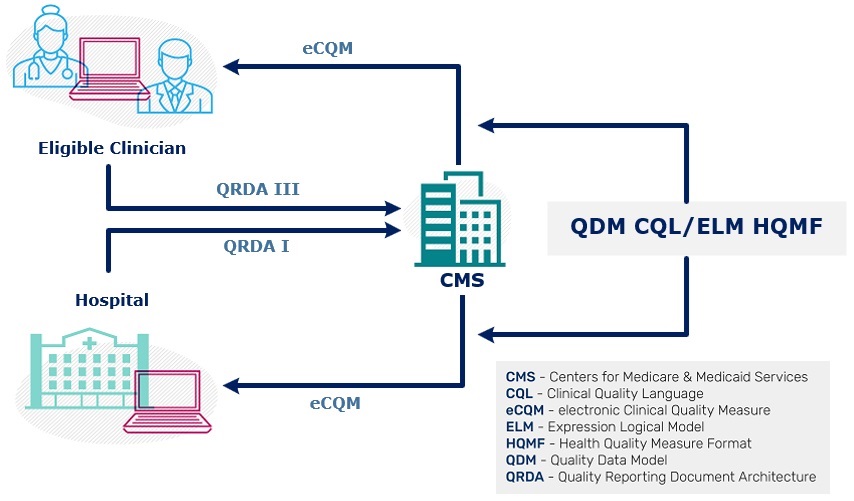
The graphic depicts the flow of quality reporting data between CMS and health care organizations. Health care organizations receive the measure specifications, expressed in Health Quality Measure Format (HQMF) using QDM and Clinical Quality Language (CQL) and then report results to CMS using Quality Reporting Document Architecture (QRDA).
For those using FHIR resources or are considering transitioning to FHIR for interoperability, the Quality Improvement Core (QI-Core) Implementation Guide provides mapping from QDM datatypes and attributes to QI-Core profiles and elements. The maps may assist implementers in understanding the meaning of QDM datatypes and attributes.